Showing posts with label Collaborative working; relationships. Show all posts

Tuesday, 22 January 2013

Why should I care who's doing my drawings?


Yet again I find myself revisiting my blog many months after I last posted - apologies!

As some of you might have picked up, I am trying to complete a series of blogs entitled "What should you look for from your Architect" the first of which can be found here, who knew that doing a series would take so long!

Earlier in the series I covered why I thought it was important that anyone looking to appoint an Architect should ask questions about their qualifications, memberships and Professional Indemnity Insurance cover. In this post I want to explore why it is important that you know who is actually going to be working on your project - hence the title "Why should I care who's doing my drawings?" 

The actual question that I posed in my original post was: "Would you be actually working on my project yourself or would other people in your office actually be doing the work, if so, what are their qualifications and how will you be checking their work?"

So, you've decided to build an extension, new house, office etc and have made contact with a couple of local Architects (always go local they'll probably be cheaper and know your local Planning Department, Building Control officers and local builders) and have asked them to come over to have a look at your site* and now you're face to face with a very presentable person who seems to know what they're talking about and, frankly, you're convinced that this firm is "the one"!

*note: Most Architects will happily come out to your site and spend about an hour with you without charging you for the privilege, if they won't then go elsewhere as these firms are likely to charge you for ever last minute of their time! Visiting site gives us a chance to understand your site and you and to work out just how big the project is, how complicated the site is and whether we are going to be able to work constructively with you - all factors that affect the fee that we charge - remember we are selling our time and expertise!

So, back to the narrative;

Imagine, having signed up to work with the nice Architect you met on site, that you then meet the person who is actually working up your dream project and you discover that they are fresh from University, don't have a clue about what you want or how to build it and, worst of all, are wearing a dirty Arsenal shirt - not quite what you had been led to expect!

Most architectural firms will have staff with a wide range of qualifications and experiences and the fact that the chap working on your scheme is not very experienced is not, in itself, a major problem as long as they are being properly supervised by someone who is properly qualified and experienced.

So why should you ask the question that I posed at the top of this post - frankly because you need to know that the project is in safe hands. A good practice will have systems in place to ensure that staff with less experience are being guided, mentored and encouraged as they develop within the business and that all the work that they produce is being checked thoroughly by a qualified, Registered Architect.

If the nice, well presented person in front of you is not able to answer the question without looking a bit shifty then walk away - you don't need to be employing a salesman as well as an Architect!

Monday, 18 October 2010

Market Square - a design proposal for rebalancing the Town Centre

As some of you will know, Alastair Howe, another local architect, and I recently presented proposals to Harlow Renaissance for the regeneration of Market Square in Harlow. As promised, the content to our proposals is reproduced below and we would welcome your comments, thoughts and observations.


Introduction:

Following the withdrawal of Stockland from Harlow Town Centre North Development Proposals in 2010, a group of local Architects, concerned about the stagnation of plans for the reinvigoration of the Town Centre, met with Andrew Bramidge - Chief Executive of Harlow Renaissance, to discuss their concerns, emerging thoughts and ideas for the future of Market Square.

Since that initial meeting, the architects involved have continued to develop their initial thoughts and concepts with the aim of producing a document that provides inspiration for the future direction of Market Square, recognising and addressing its shortcomings whilst building upon the strengths of the original concept, vision and urban fabric.

We hope that this document will help to inform future discussions, not only about the short term future of the Market Square, but also about the reuse and retention of the stronger aspects of Harlow’s Urban fabric and ground breaking master plan

© Mark Cotton
Alastair Howe
Michael Cochrane

October 2010


Market Square:

A Market Square was mooted as part of the original 1947 Plan for Harlow New Town; it was considered that the town would develop as a Market Centre for the Region. A Square more or less orientated as it is now appears in the 1952 Master Plan drawing of the Town Centre. This area of the Town Centre was the first to be completed, with the first shops opening in December 1955. The Market Square was conceived as one of four civic squares in the Town Centre. The first market in the Square took place on 16 May 1956.

Frederick Gibberd recalled that he had “proposed that a market should be the principal space or focus of the north of the Town centre because of my love of the oldest form of English shopping. My grandparents' living room overlooked Nuneaton Market and the scene lit at night by paraffin flames, with its jostling crowd, strident colours and harsh noise has never left me.”

In recent years Market Square has deteriorated significantly. The original trees were removed to provide more space for market stalls, permanent market canopies erected and the surrounding buildings, as well as the surfaces finishes of the public realm itself, have suffered from a lack of regular maintenance.

In addition to these physical symptoms of neglect, Market Square has been significantly affected by the Water Gardens development. The migration of quality retail outlets and footfall to the southern end of the Town Centre has left Market Square somewhat distant and the quality of retail offer has subsequently declined, leading to a lack of animation in what should be a vibrant urban square as Gibberd envisaged.

The market, which should animate the square, has itself declined in quality. This probably has much to do with the wider decline in general of markets as opposed to the particular specialist offerings. When combined with the poorly considered permanent structures, street furniture and paving, this decline in quality has added to the sense of decrepitude, desolation and inactivity in Market Square.

A vicious circle is affecting the Market Square: A perceived lack of quality offer, retail or otherwise, has led to a decline in footfall which, in turn has led to a lack of investment which has affected the perception of the square which further affects the quality of the retail offering.

Recent initiatives to improve Market Square have met with mixed success. The creation of a temporary gallery (below) in 2008 for a variety of artists' projects, clad in a series of designs referencing current and past architectures in the town, was deemed to be very successful in increasing footfall through Market Square and subsequent activities in Market Square have had a similar effect.


The installation of a number of trees in planters in the northern parts of the Town Centre have also been successful in beginning to alleviate the sense of desolation although the lack of maturity and permanence of this greenery is very apparent and their positioning leaves something to be desired in terms of creating a legible urban environment.


Priorities:

We recognise that the first priority for proposals of the nature contained herein has to be to break the vicious circle. For any regeneration project to be successful, be it a new build scheme or an enhancement of the existing urban fabric, steps have to be taken to improve public perception of the area and to drive footfall though. It is only through an increase in footfall that retailers and landlords will be persuaded to recognise the value of Market Square and invest accordingly.

Rather than advocating a “knock it down and start again” approach, we favour an approach that relies on small to medium, targeted, interventions that will act as a catalyst for the release of further, private, investment. To this end, our priorities are as follows:

- Visible activity within Market Square when viewed from the main routes within the Town Centre (e.g. Broad Walk);
- A sense of place and destination within Market Square;
-  A quality Public Realm and Urban Environment within Market Square

Obviously the state of the surrounding built environment does need to be addressed. One of Market Square’s great strengths is the quality of the design of the enclosing structures, although this can be hard to see given the clutter in the square and general state of disrepair of these buildings. It is our contention that these buildings, which form a set-piece of period design, could be resuscitated and enhanced to become a valuable asset to the town centre as a whole.

We recognise that the Local Authority does not have control of the surrounding buildings and must, therefore, rely upon the co-operation of the various land owners in achieving a full renovation of the square. However we firmly believe that if the quality of any interventions made by the Council is sufficiently high and if they are seen to be sufficiently permanent, the Council should be well equipped to encourage investment in the built environment that is outside of their control. An improved, vibrant, public realm will attract retailer demand and rental values which could be invested into the built environment, thus reversing the vicious circle.


The strength and clarity of the architecture in Market Square offers the opportunity to refurbish facades and clean up existing features to create a surprisingly contemporary backdrop for the activities that we envisage in the square itself.


Enhancing existing visible activity:

It is not enough to simply create activity within Market Square, the activity generated has to be sufficiently visible to draw people through the Town Centre, towards and into Market Square. It should also be planned such that it hints at further activity which is revealed as people move towards it.

Visible activity reinforces a sense of place and creates a sense of destination for those viewing the activity from outside.

It is also insufficient to create activity tied to specific times. A busy Market Square is no asset to the Town if, at night, the same square is deserted and foreboding. A successful urban environment must generate activity for a wider timeframe, one that includes early evenings and, potentially, late into the night.

Currently the main source of activity in Market Square is either transitory - people moving through the square on their way through to, or from, the more vibrant retail areas beyond or related to the market and bank. It makes sense to enhance this current level of activity as an early phase of a larger, co-ordinated, attempt to re-introduce visible activity into the square.

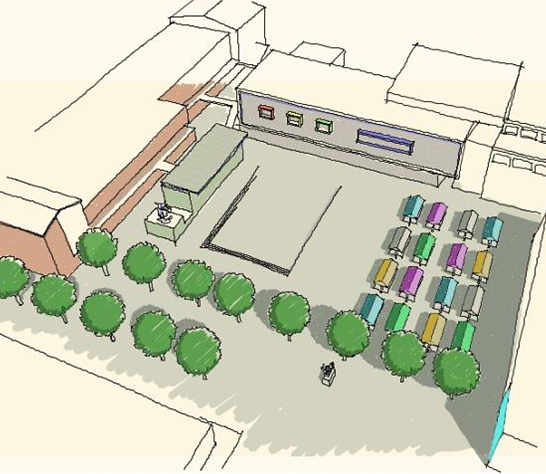
We propose that, further to the removal of the fixed stall canopies, the market be relocated so that it is visible, but does not dominate the whole aspect, from the main axis running up Broad Walk. This would reduce the area occupied by the market thus offering the possibility of an intensification of activity on this primary axis and would free up space for complementary activities within the square.


In relocating the market to the Eastern edge of the Square there exists an opportunity to reinvent and reinvigorate the market itself. One of the problems that the current arrangement creates is that the concept of a traditional general market has been lost. The current offering of stalls is somewhat varied and many traders have been allowed to sprawl across a number of pitches in an effort to make the market look larger than it is.

We would encourage the Council to explore the possibility of reducing the size of individual pitches to create a larger number of smaller pitches with a greater variety of goods. Whilst we recognise that the current economic circumstances and the rise of supermarkets have threatened the future of markets, we believe that a market that offers start up businesses and small traders an opportunity to display and sell their wares without the high overheads that a shop or similar premises would entail will generate visual variety and interest and, in turn, attract footfall.  


By providing other activities within the Market Square, casual shopping at stalls could begin to occur. It is also possible that specialist markets could occupy stalls from time to time to tie in with specific events that might take place in the newly created activity space.

Pitch sizes could be determined either by the use of markers within the paving of this area or, alternatively, by the design and construction of properly considered semi-permanent stalls.


Creating new visible activity:

Strengthening the visibility of existing activity within Market Square is a sensible and cost effect starting point, however the introduction of new activity is central to restoring a sense of destination and purpose for this key urban square. The relocation of the market will not only make it more visible from the main shopping area of Broad Walk but will also free up space for other activities. Whilst a vibrant market may well be sufficiently attractive to increase footfall during the day and could function, on occasion, into the evening, it is unlikely that it will be able to generate additional evening activity in Market Square all year round. The right additional evening activity in Market Square could, however, increase the market’s night-time viability.

We propose that the Council refurbish the existing two storey building to the western side of Market Square. This building could accommodate a gallery and perhaps an information centre dedicated to Harlow New Town, its architecture, planning, sculpture, biodiversity and all the other assets the town possesses. The gallery could support the Gatehouse Arts Project as well as existing, established local artists. It could also provide a “neutral” exhibition venue for future consultation on the regeneration of Harlow.


Coupled with the refurbishment of this unused building, and key to increasing the vitality of the square, we propose that an external video screen be erected on the side of the building, facing the square, and an associated programme of public realm works be undertaken to create an outdoor cinema which could be used to screen films. We propose that this space would also create a venue for performance art, school shows, concerts or other such seasonal activities. During the day the screen could be used to raise revenue by screening adverts or perhaps screen channels such as BBC News 24, providing animation. It could display video art related to the gallery use.

By adjusting levels in front of the proposed screen, a stage area can be formed with a lower level area for seating. This area could feasibly be transformed into a skating rink in the winter months. We propose that the single storey Market Office be retained to form a plinth for a major piece of sculpture.

To support the newly created open air cinema and performance venue, we would suggest that one of the adjacent vacant retail outlets to hire out deck chairs, which would also potentially generate revenue. We would also encourage the Council to establish a programme of events and entertainment for this outdoor facility that coincides with the programme of exhibitions etc in the newly created internal gallery spaces. If properly considered, a programme of night markets timed to coincide with events could prove to be very successful.


The introduction of a facility such as proposed here will provide a much needed focal point for the square, during the day this new public space would provide a quality environment for those who work in the surrounding offices or who are shopping in the Town Centre and, at night, could provide an incentive for people to use Market Square as a social gathering spot. When coupled with a vibrant night market, the square can become, once again, the location for communal gatherings and celebrations in Harlow, with the jostling crowds, strident colours and sounds envisaged at the inception of the square.


Creating a sense of place and destination:

The reorganisation and reinvigoration of the market, coupled with the introduction of a viable use for the vacant building in Market Square will go a long way towards creating a sense of activity and “destination” but the square itself needs to be redefined physically to make it a more intimate urban space.

We propose introducing trees (see above) to define areas of the greater square as more intimate spaces to meet friends, rest and play. The trees will also provide a heightened sense of enclosure to the square as a whole whilst still allowing the capacity for larger gatherings. The proposed line of planting frames a view of the Adams House Clock and would establish a strong, natural, backdrop for the listed sculpture on the axis of Broad Walk. Introducing mature trees would provide a natural softening to complement the hard surfacing of the square and surrounding areas.


We also suggest that a high impact lighting scheme is designed and implemented for Market Square. The scheme should not only improve the levels of general lighting in the square at night, which will encourage people to gather in this important urban space, but should also highlight the physical attributes and features of the surrounding buildings, for example the clock and the concrete perimeter of the glazing to the building on the northern boundary of the square, helping to reinforce the sense of place and identity of Market Square.


Creating a quality public realm:

It is not sufficient to simply create and enhance activity in Market Square if the intention is to reinvigorate this end of the Town Centre and thus attract a higher quality of retailer to Market Square. For Landlords and Retailers to have confidence in the area, the interventions that are made must be seen to be made in a meaningful and committed manner. Key to achieving this is investment in the Public Realm: This should be a mixture of short, medium and longer term strategies to further enhance the urban space over and above the improvements outlined in this document.

In the short term, the strategy should focus on short term gains that can be made without great financial expenditure. For example painting the hand railings around the raised walkways and staircases of The Rows would indicate a level of commitment to the area immediately.

In the medium term, a full programme of refurbishment and replacement of pavings and signage should be developed as this will have a significant impact upon the visual quality of the square. The programme could be implemented over time, for example the removal of the permanent canopies could include the repaving and formation of the sunken area proposed elsewhere in this document however, an overarching design should be agreed as soon as possible to avoid abortive or repetitive works.


In the long term, we would encourage working with surrounding land owners to address the issues of poor maintenance of the facades overlooking Market Square. These works could be as simple as instigating a proper redecoration and maintenance programme. An example of a more ambitious approach would be to see Market House reglazed with a contemporary curtain walling system and have the projecting elements expressed, using coloured renders, as architectural elements. This building has the potential to become a striking, iconic, architectural feature helping to establish a strong identity for the whole of Market Square.

Thursday, 9 September 2010

Reactions to "A manifesto for change - Part 1"


My last post has generated quite a bit of reaction - I didn't realise that people might actually read it, silly me!

I received emails and comments through facebook that deserve to be read by people who read the original blog and to which I would like to respond in a public forum.


So firstly, the email I received from Andrew Bramidge who is the Chief Executive of Harlow Renaissance. Andrew's email is as follows:

"Hi Mark

I read your blog the other day – thanks for the comments and sentiments there. As you rightly identify, the critical question is what happens next and we will be working hard with the Council and others to ensure that there is a strong legacy and that much of the work continues. Clearly that will not be easy in the context of public funding cuts (and which is why we are having to close!). A key piece of work is the Design Guide and we will be pushing to get this adopted as formal SPD.

In relation to your comment on the town centre,

"Why not encourage Land Owners to partner with the Council to deliver meaningful redevelopment of individual properties or groups of buildings within an agreed brief and design framework?"

this is precisely what we [Harlow Renaissance] are now doing. We are working with our design team on a range of masterplanning options (reduced scale, less land acquisition and phased) which we can then discuss with existing landowners how they can bring forward developments that are consistent with this. We aim to have a draft of something in October.

For parts of Town Centre North where there is a multiplicity of owners we will still be undertaking an OJEU process, but we see scope for a number of developments coming forward against an agreed brief. In the current climate we feel this is a more realistic scenario for delivery.

I would take exception with one of your comments about us being a Quango (which we are not!) and that our existence meant that the future of the town was being determined by people with no connection with it. I could make the point that five of our thirteen board members live in Harlow and another two run business here and also that three of our six staff are long term Harlow residents, so to say that we have “no connection” with the town is just false!

However, that would actually be missing the point in that we are a delivery body and not a decision making one. We do not plan the future of the town (although at times I wish we did!) or have any responsibility for strategy. Our role is to implement the decisions that Harlow Council as the democratically elected representatives of the town have agreed upon. We actually have no powers of our own.

Regards,

Andrew"


I am really pleased that the momentum for change that Andrew and his colleagues have so successfully generated is not to grind to a halt during the next few months as Harlow Renaissance is "wound down".

The fact that the Design Guide is to be completed is great news and I urge the Council to adopt this as soon as possible as it is long overdue.

I remain concerned that the regeneration of Harlow Town Centre North is being approached from the perspective of a wholesale redevelopment on a grand scale. I would prefer to see a gradual replacement or refurbishment and adaptation of the existing building stock so that the urban grain of the town centre does not disappear. One of the major problems with the Water Gardens development was, and is, that it totally ignored the pre-existing urban grain and established it's own which is incompatible with the rest of the Town Centre.

I still remain convinced that some of the buildings that are in the Town centre are incredible pieces of early modern architecture and could and should be retained, brought up to date and form the skeleton of the new Town Centre.

Regards my use of the term "Quango", I apologise to Andrew - this was simply a lazy use of language which I have now rectified on the previous post.

For the record, the five board members who live in Harlow are as follows:

Cllr Andrew Johnson - Leader, Harlow Council
Cllr Chris Millington - Leader of the Opposition, Harlow Council
Cllr Mark Wilkinson - Leader of the Labour Group, Harlow Council
Cllr Eddie Johnson  - Deputy Leader Harlow Council
Jackie Sully - Chair, Harlow 2020

In addition, I think that the two board members who run businesses in Harlow are:

John Keddie - Vice President of R&D Operations, GlaxoSmithKline
Steve Hammond - Former Managing Director, United Glass

Andrew is quite correct in stating that Harlow Renaissance are simply a "delivery agency" but the reality is that they have also been doing a significant amount or work in shaping the views of the decision makers in the Town. This is no criticism, in fact I am hugely grateful to Harlow Renaissance for the work they have done in this area. My concern is that without an organisation like Renaissance, the will to implement change will diminish and the skills that are needed to set out a long term vision for the Town will be imported from London without any thought to the skills the Town already has at it's disposal.


I also had some other comments via Facebook which I won't publish in their original state. Suffice it to say that I have always been an advocate of small businesses being part of the solution and Local Authorities often overlook such businesses because of their size rather than recognising their flexibility and, often, value for money!

My recent comment on Twitter which said something along the lines of "Well that's 2 yrs of networking & gaining influence down the tube!" was simply a statement of frustration that, after two years of building relationships with people like Andrew and through no fault of their own, any progress that we, as a practice, had made was effectively wiped out.

I am, as stated above, an advocate of small and steady changes when it comes to regeneration, rather than "grand gestures" and firmly believe that The Water Gardens was and is a disaster for Harlow in terms of urban planning. Future regeneration phases will find it extremely difficult to reconcile the urban form of the Water Gardens and the Town centre will, in my opinion, forever be split in two.

As I said in my previous post, please leave comments as you see fit or contact me through the usual channels as I firmly believe that the best way to maintain the momentum for change is to talk about how regeneration should be delivered in Harlow. You never know, my manifesto "part 2" might include some of your ideas!

The photos used in this blog are courtesy of the Harlow Civic Society

Monday, 6 September 2010

A manifesto for change - Part 1!


If you've read my last post you'll know that Harlow Renaissance, Harlow's regeneration company, has announced that it is to "cease trading" at the end of the financial year. Since i wrote the piece last week, I have been giving some thought to what my "manifesto" would be if I were seeking office on the single issue of "Regenerating Harlow". This post is my fledgling attempt to articulate some of my thoughts and I'll probably return to the subject over the next few weeks and months as the situation becomes clearer and as my thoughts develop.

1. Harlow needs change and change is good

There is little doubt that Harlow, as a town, is in need of change! Many of the buildings are no longer fit for purpose and the infrastructure of the Town is sadly lacking. This need for change is not a result of failure, as many would have you believe, but of changes in the way we lead our lives that could not have been reasonably predicted 50 years ago and by poor quality and ill conceived development that, rather than improving the pre-existing problems, has in many cases undermined the solid urban planning principles that the town is founded upon.

Change can be a force for good, improving situations where hope has been long abandoned and bringing light where once all was dark.

Change almost always brings with it fear - fear of the new, fear of failure, fear of making things worse than they already are, but fear is not constructive, fear stops things happening rather than acting as an encouragement - now is not a time for fear!

As a Town we should embrace change and new ideas (we are after all living in a groundbreaking urban environment that was all about a new way of doing things) we should encourage innovation in our business sectors and we should support and spur on our Local Authority as they seek to bring in the necessary change to our built environment.


2. Small changes can be more effective that grand gestures!

It's easy to be seduced by the idea that a "grand gesture" will solve all the known problems in one fell swoop however I firmly believe that, whilst occasionally this may well be true, often small, incremental changes can be far more powerful drivers for improvement that wholesale redevelopment.

In Harlow, for example, the Water Gardens Development which was completed in 2004 was intended to improve facilities within the Town and created some 45,000 ft2 of "leisure spaces" and created a new Town Hall. It was a grand gesture that has been very successful in bringing new people into Harlow, mainly to use the new shops that have been attracted to the development. however, in creating a new shopping "zone" The Water Gardens development turns its back (physically) on the old Town Centre which had the (almost) immediate effect of killing off any chance that the northern half of the Town Centre ever had of passing trade. As a result Market Square is dying a slow and lingering death by pawnbroker and charity shop!

Any Town Centre development needs to recognise the importance of maintaining a balance across the whole of the retail offering and, in the case of Harlow, the strength of the urban form that exists. Yes Harlow Town Centre's buildings are suffering from old age and poor maintenance but this should not automatically condemn them to becoming hardcore. One of the, often overlooked, aspects of Harlow Town Centre is that, when you look beyond the grime and peeling paintwork, many of the buildings have the early DNA of today's contemporary masterpieces.

I would resist the lures of wholesale "regeneration" and embrace the opportunities that the existing buildings and urban environment offer for re-imagining the early days of Harlow New Town.

I would focus on re-balancing the quality of the public realm so that those areas that have been long ignored and overlooked become, once again, spaces that offer something new and different to the population of Harlow.

In these times of financial restraint, I would look to work with existing land owners to encourage them to partner with the Town in improving the quality of the space enclosed by their buildings which could only lead to increased footfall and trade and thus increased revenue streams and property values for them.

I would reject any attempts to bolt additional housing on to the outskirts of Harlow until the problems of poor housing stock and infrastructure in the existing neighbourhoods have been addressed and it can be demonstrated that the demand for new housing can not be met through intensification without damaging the individual and collective character of Harlow's neighbourhoods.


3. Change is more effective when it is made collaboratively, involving the people it affects!

Change is often, as I have said above, associated with fear and uncertainty, it can often be undermined before it has even got going by the inertia that doubts can cause. If change, at a town wide level, is to be effective, it has to be brought about with the support of local people, businesses and interest groups.

Consultation can often sound the death knell for any project if the purpose is not clearly stated at the beginning of the process. It will never be possible to get every single person to agree on what, where, how and when regeneration should happen. It is possibe however to give people to opportunity to express their thoughts and comments and to be heard. it is possible to make people feel part of the process of regeneration and to take ownership of the changes that result.

Alienating individuals and organisations by simply ignoring them because they might disagree with you simply stores up trouble for later down the line as campaigns and petitions gather pace.

I would look to set out clearly, at the earliest possible point in time, what the overarching aims and ambitions are for the regeneration of Harlow. I would use inclusive language rather than industry jargon and I would look to explain why the priorities are as they are and what the signs of success will be.

I would encourage local business to be part of the soloution and would look to use physical regeneration as a driver for the economic regeneration of the Town.

I would encourage local residents to contribute to the shaping of a new vision for Harlow in the 21st century and beyond - letting them know that their thoughts are just as valid and as important as the professionals and Councillors that will be, neccesarily, pulling together the various strands that will make up a Town wide regeneration work.

I would encourage the local politicians to put behind them any party political loyalties and work together as a body to bring strong leadership at a time where many will be looking for certainty and decisive decision making.


So those are my first three manifesto 'pledges' I hope they made sense and that you enjoyed reading them.

To summarise, change is neccesary, can be a force for good and can be more effective when undertaken in small, bite sized, steps with the involvement of those it affects.

Let me reassure you all that (at the moment) I have no intention of standing for any kind of office. However, if Harlow Council want to talk to me about shaping the future of the town they know where to find me!

As always I would welcome your thoughts and comments - interaction is always good!

Friday, 3 September 2010

What next for Harlow?

After a few weeks of rumours and speculation, it has finally been confirmed that Harlow Renaissance, Harlow's regeneration company, is to cease trading at the end of the financial year.

Tuesday, 3 August 2010

Collaborate working - what's new?


As those of you who follow me on Twitter will know from recent tweets, I spent most of the weekend at the Parndon Mill Open Studios mixing with the creative community that calls this amazing place home.

Parndon Mill was mentioned in the Domesday Book as having two hives and a goat and is now a hive of creative activity. The four storey mill and outbuildings provide studios and workshops for artists, craftsmen, designers and architects.

As a place to work it is not only fantastically pituresque but also a very real example of how individuals and companies in differing fields can come together to work towards a common goal and suceed.


Since moving in here three and a half years ago, we have worked with almost all the inhabiants of this building to achieve a number of different goals. we have worked on hospitals in Ethiopia with BuildAid who are on the floor above, made templates for handmade classical guitars, advised painters on how to approach large murals and developed sculpters plans for large scale public works.

We regularly have painters & other artists "popping in" to see what is happening in the world of architecture, they contribute to schemes that we are developing, casting a constructive eye across drawings & sketches & making observations that improve our concepts immeasurably.

The Open Days at the weekend were a public outworking of this mentality of collaborative working with everyone mucking in to serve teas and coffees, man the studios and gallery and generally make the event a huge success.

The trade magazines these days are constantly telling us, as a small practice, that we need to get our heads around collaborative working to survive. At the same time those publications are telling us, as Architects, that we need to re-establish our position & respect within the construction sector.

On the face of it this appears to be somewhat of a contradiction but, in my opinion, this is not the case.

During my time at the University of Westminster (BA Hons Architecture) the assumption was always that, as Architects, we would need to collaborate with others to make our designs a success. The University rightly took great pride in bringing together students of different diciplines to work on common projects and develop a language of cooperation and shared goals.

Once I entered the profession and started to see at first hand "the real world" of Construction I was shocked at how confrontational the process was with Clients, Contractors and Local Authorities all treating each other with distrust and, in some case, downright contempt! Ever since I have been absoloutly convinced that building a team ethic between stakeholders in projects is key to the project being delievered to everyones satisfaction.

I do not subscribe to the idea that collaborative working is a new idea but I do think that the current focus on small practices collaborating with larger outfits is simply one element of a larger picture. I believe that, for Architects to regain their reightful position within the industry, we have to be seen to be developing relationship with Local Authorities, Clients, other practices and Contractors alike so that we can initiate useful dialogue around projects and ensure that we genuinely add value throughout a projects gestation and delivery.

We have, for the last year or so, been working this out in practice and are starting to see the rewards. these vary from achieving a Planning Permission for a scheme that faced significant opposition but was approved because of the "high quality of design" through to being invited with another practice to develop proposals for the regeneration/facelift of a key area within Harlow. Neither of these opportunities would have come about without investment in relationships and building trust and respect and there is more fruit on the tree simply waiting to ripen.

If you are interested in developing a relationship with us as a practice, please contact me through our website or drop me a tweet!