Showing posts with label Architects. Show all posts

Tuesday, 18 November 2014

Why should I want to speak to my Architect's past Clients?


Once more I find myself returning to our blog after a substantial absence stemming from an overly complicated and busy life!

This is my last blog dealing with what you should ask your architect before appointing him to your project. If you haven't read the rest of the series, you can click on the links below starting with the first post on this subject.

To summarise the theme, we are very rarely asked the three or four questions that I WOULD ask if I were in a prospective client's shoes. In previous posts I have touched upon the first few questions namely:


4. Will your quote break down what you have to do into manageable and clearly explained stages so that, if I decide to stop, I know how much I owe you as well as when you will be invoicing me?

and finally, in this post:

"Do you have any Clients I can speak to or completed projects I can visit that are similar to my project?"

You would be amazed at how infrequently we get asked this question by prospective clients (most are simply interested in the bottom line) but occasionally 'switched on' clients ask whether we would mind them speaking with clients for whom we have carried out similar projects and we are more than happy to oblige!

Let me explain why....

Firstly, we are proud of the work that we have completed in the past and the fact that the vast majority of our clients are not only happy to talk about their experiences in working with us on their projects but also happy to show off the finished project to others who are in the same situation that they were when they were considering whether or not to employ us as their Architects.

If you have happy past clients then why would you not be willing to introduce them to prospective clients?

Secondly, working with an Architect is not the same as purchasing a 'product' it is a collaborative exercise where the ability to work together is critical to the success of the project regardless of whether you are simply wanting a Planning Permission or want your Architect to provide a full service up to the completion of your project.

Most Architects are pretty good and experienced at working with clients to understand their requirements and deliver projects that meet them but, as in any sector, some are more 'people orientated' than others.

Unless you have chance to speak with someone who has gone through that process with your chosen Architect you will only find out what they are like to work with once you are committed!

Asking the question posed at the top of this post allows you, as a prospective client, to judge not only the quality of their work but also the manner in which they approach their clients and projects. If someone is unwilling to let you speak with past clients or only offers up contractor clients (where you can not be sure what the relationship is) then this should ring alarm bells - after all if they are not proud of the work they've completed...............

On a different note, I hope that this post will be the start of a period of time where I will be blogging a bit more regularly on architecture & construction generally - so watch this space!
 

Wednesday, 13 February 2013

Why should I ask about how my Architect's quote will be structured?


This is my penultimate blog in a series about what you should ask your architect before appointing him to your project. The series stems from a period of time where we were being asked a wide variety of questions when quoting, many of which were completely irrelevant and couldn't have been of any realistic help when the (prospective) Clients were considering who to appoint to deliver their project.

As you will have read in my first post on this subject, we are rarely asked the three or four questions that I WOULD ask if I were in their shoes. In previous posts I have touched upon the first few questions namely:


The next question in my list is as follows:

"Will your quote break down what you have to do into manageable and clearly explained stages so that, if I decide to stop, I know how much I owe you as well as when you will be invoicing me?"

Now you might be forgiven for thinking that the answer to this question is obvious, in fact it often isn't as many architects and other consultants have a variety of ways in which they structure their quotations - some give clarity, others offer clarity if you're prepared to do a bit of research and other methods give little or no clarity at all. Lets look at the most common structures for consultants quotes:

RIBA Outline Plan of Work 2007
 
The RIBA Outline Plan of Work 2007 is a useful document which breaks the life of a construction project down into stages (A through to L) with a description of key tasks associated with each task.

Many Chartered Architects will structure their quotations around the various stages, for example getting you to a Planning Application might cover stages A through D whilst Building Regulations Approval is achieved at the end of stage E with tender actions being covered by stages F through H.

Whilst this is extremely useful on complex projects where many complicated and interlocking tasks have to be carried out, for a smaller project this level of complexity can be somewhat overwhelming and reference to work stages as opposed to outcomes can lead to confusion, particularly for domestic clients who will have to look up the relevant document and then try to work out which stage they are on at any moment in time.

To be fair to the RIBA, they have recognised this and are currently in the process of replacing the Plan of Work with a revamped version, the consultation document can be read here, which will simplify the workstages down to seven easily understood stages that apply equally as well to all scales of project.

Hourly Rates

Some building consultants have chosen to disregard the RIBA Plan of Work and instead have adopted the approach of Solicitors or Accountants, charging by the hour.

Putting to one side, for a moment, what an Architect is "worth" in terms of hourly rates*, I want to focus instead on the lack of transparency involved when someone quotes on the basis of an hourly rate.

How long does it take to prepare and submit a Planning Application or a Building Regulations Application? How long does it take to survey and draw up an existing building? How long is a piece of string? How complicated is your project?

Frankly whilst we as Architects effectivly sell our time and expertise, how can we expect a customer to understand how complex their project is and how involved our role is and thus how long the project is likely to take from our point of view. Most of our clients have no idea how long it takes us to put together a Design Statement, Access Statement or any of the other multitude of documents that we have to submit in support of a Planning Application these days let along the drawings for their project which "coz it's done on a computer probably takes you no time at all"!

If we, as Chartered Architects, are to provide proper support to a client as they embark on their project, surly the first thing we should be doing is being clear about our fees and the added value we bring to a project. Not only does this allow them to budget properly (minimising the risk that they default on our fees) it also builds trust that we will be up front and clear about the costs they might expect to incur.

In my opinion, quotes based on an hourly rate should be stuck straight in the bin!

*Coming back to what an Architect is "worth", consider this:

- Architects train for a minimum of seven years before being eligible to sit their final professional exams which are required before they can register as Architects - more often than not the training takes eight years to complete;
- In contrast Solicitors train for about 6 years, Accountants for 5 years.
- Solicitors can charge £200 plus per hour whilst Accountants will regularly charge £150 plus.

So what's your Architect "worth"........more or less than your Solicitor?

Bespoke stages:

At Architecture & Design Services we quote for the vast majority of projects on the basis of bespoke stages with the outcomes defining the stage. For example a domestic project might be broken down as follows:

Stage 1: Survey the existing building & prepare existing drawings for the basis of further design work.

Stage 2: Prepare outline designs for Client approval, make all neccesary revisions and prepare and submit a Planning Application the agreed scheme.

Stage 3: On receipt of a Planning Applicatiomn, prepare and submit a Full Plans Buildign Regulations Application.

and so on.

The advantages of this approach speak for themselves. The Client knows exactly what to budget for, how much is due at each stage and when that stage falls complete.

So, why ask the question, because frankly you want to know how much you're going to be paying for your Architect's services and when that money is going to be due!

Tuesday, 22 January 2013

Why should I care who's doing my drawings?


Yet again I find myself revisiting my blog many months after I last posted - apologies!

As some of you might have picked up, I am trying to complete a series of blogs entitled "What should you look for from your Architect" the first of which can be found here, who knew that doing a series would take so long!

Earlier in the series I covered why I thought it was important that anyone looking to appoint an Architect should ask questions about their qualifications, memberships and Professional Indemnity Insurance cover. In this post I want to explore why it is important that you know who is actually going to be working on your project - hence the title "Why should I care who's doing my drawings?" 

The actual question that I posed in my original post was: "Would you be actually working on my project yourself or would other people in your office actually be doing the work, if so, what are their qualifications and how will you be checking their work?"

So, you've decided to build an extension, new house, office etc and have made contact with a couple of local Architects (always go local they'll probably be cheaper and know your local Planning Department, Building Control officers and local builders) and have asked them to come over to have a look at your site* and now you're face to face with a very presentable person who seems to know what they're talking about and, frankly, you're convinced that this firm is "the one"!

*note: Most Architects will happily come out to your site and spend about an hour with you without charging you for the privilege, if they won't then go elsewhere as these firms are likely to charge you for ever last minute of their time! Visiting site gives us a chance to understand your site and you and to work out just how big the project is, how complicated the site is and whether we are going to be able to work constructively with you - all factors that affect the fee that we charge - remember we are selling our time and expertise!

So, back to the narrative;

Imagine, having signed up to work with the nice Architect you met on site, that you then meet the person who is actually working up your dream project and you discover that they are fresh from University, don't have a clue about what you want or how to build it and, worst of all, are wearing a dirty Arsenal shirt - not quite what you had been led to expect!

Most architectural firms will have staff with a wide range of qualifications and experiences and the fact that the chap working on your scheme is not very experienced is not, in itself, a major problem as long as they are being properly supervised by someone who is properly qualified and experienced.

So why should you ask the question that I posed at the top of this post - frankly because you need to know that the project is in safe hands. A good practice will have systems in place to ensure that staff with less experience are being guided, mentored and encouraged as they develop within the business and that all the work that they produce is being checked thoroughly by a qualified, Registered Architect.

If the nice, well presented person in front of you is not able to answer the question without looking a bit shifty then walk away - you don't need to be employing a salesman as well as an Architect!

Friday, 17 June 2011

Why should I ask about my Architect's insurance?


This is the second part of a short series that is trying to give some guidance about the questions you should ask your 'architect' before entrusting them with your most valuable asset - your property!

My introduction to the series can be read here and the first post in the series, dealing with making sure your consultant is properly qualified, can be read here.

So, why should you worry yourself about your consultant's insurance cover - after all they're only doing some drawings aren't they!

Firstly, let explain what Professional Indemnity Insurance (PII) is:

Professional Indemnity insurance is held by many different types of professional to cover them for claims for loss or damage made by a client or third party should they, the professional, make mistakes or are found to have been negligent in some or all of the services they provided.

Registered Architects are required to carry PII as a prerequisite to being registered and must keep up that insurance for a minimum of 12 years after they cease practicing. This is designed to protect you, the client, against the worst case scenario!

So what might go wrong?

Honestly - it's very unlikely that anything will wrong but, in the last few years, we have regularly been contacted by people who have been given incorrect advice by unqualified 'designers' which has led to them building extensions or making alterations to their property without the necessary permissions.

Legislation around building works has become more and more complex over the past few decades. Most projects will need Planning and Building Regulations Approval - both of which areas are constantly changing, in addition you may also need Covenants Approval and/or a Party Wall Award! If your 'consultant' gives you incorrect advice and you don't have all the necessary permissions you might have to undo the work that has been undertaken - a costly experience!

If your 'consultant' or 'designer' does not carry PII, or is reluctant to discuss this matter with you, it should set off alarm bells! It may be an indicator that they are not registered with an appropriate professional body such as the ARB, RIBA, RICS or CIAT.

The level of cover carried should be appropriate for the size of project. Most policies are 'each and every claim' which means that each (unlinked) claim made is dealt with on it's own merits so it is not always necessary to look for cover that exceeds your budget - most architects will ensure that they carry sufficient cover for the type of work they undertake.

So some pointers to conclude:

1. It is very unlikely that you will ever need to make a claim on a reputable, properly qualified, consultant.
2. All qualified, registered, consultants will carry PII and be happy to talk to you about the level of cover carried.
3. Most unqualified 'designers' won't carry PII.

Most importantly:

4. PII is carried to protect YOU!

Asking your consultant for details of their PII cover, at a very basic level, is a great indicator of wether your consultant is truly professional whose advice you can rely on or simply someone doing pretty drawings!

Don't forget - your property is your most valuable asset - can you afford to take the risk of using anyone other than a properly qualified, insured, registered professional?


Tuesday, 24 May 2011

Why should I ask about my architects qualifications and professional memberships?


This is part one of a small series of posts that all stem from a post a couple of days ago (which you can read here) which suggests five keys questions you should ask when looking for an Architect.

Let me give you a hypothetical situation and then ask you a question:

The scenario: You have been fortunate enough to have been given (or to have bought) a high end sportscar (you can visualise whatever you like at this point). Your car now needs a service and some minor but essential repairs and you would also like a couple of added extras!

The question: do you use the authorised dealer or 'Big Jim' under the arches because he's a fraction of the cost?

Now, I am not fortunate enough to own a high end sportscar (one day *sigh*) but I suspect that whilst 'Big Jim' is cheaper most people would opt to use someone who works one their model of sportscar on a regular basis and knows what they are doing, after all, it's an expensive piece of kit!!!

So, let's look at that scenario again:

You want to do some work on your house (your most expensive asset) do you go to 'Really nice Russ' who works out of his garage conversion or someone who is a qualified professional but is likely to be more expensive?

I think that, when considering any alterations to your property, you should make sure that the person or company you decide to use are suitably qualified and experienced!

That's not to say that you should always use an architect because they may not have the relevant skills for your project! Most good architects will tell you, up front, if you really require their services and, if you don't, should be able to point you in the right direction.

Regardless of which 'brand' of consultant you require, the fact remains that the membership of a relevant professional body gives you some confidence that they are 'up to the job'.

For Architects you should visit the ARB website and check that they are actually Architects (it's an offence to pass yourself off as an Architect if you are not registered with the ARB).

For Surveyors and Structural Engineers, the RICS is a great starting point.

'Architectural Technician' is often a term used by unqualified designers but you can check with the CIAT to see if they are actually technicians or simply unqualified 'designers'.

Finally, a word of warning! There is no such thing as an 'Architectural Designer' - if your consultant says that this is what they are dig a bit deeper, after all you wouldn't trust 'Big Jim' with your Bugatti, why trust 'really nice Russ' with your Home?


Tuesday, 8 February 2011

Does Michael Gove have a point?


If you read the same type of magazines that I do, you'll know that the Coalition Education Secretary, Michael Gove, has raised the blood pressure of "the architectural community" with some apparently ill considered and uneducated comments about the role (and cost) of Architects within the education sector. At the risk of being lynched by my fellow professionals I have been wondering whether Mr Gove does actually have a valid argument!

Firstly, lets actually consider what he said:

Prior to his ministerial appointment in the new coalition government Mr Gove said Architects were ‘creaming off cash’ under the £55 million BSF programme.

Then, on 2nd June, in the House of Commons and during a debate Mr Gove stated that:

"...I know that Building Schools for the Future makes a distinguished contribution to ensuring that we renovate and refurbish the schools estate, but I have concerns that under my predecessor the programme was not allocating resources to the front line in the most efficient way. It is critical that we ensure that taxpayers’ money is spent on the front line improving education, and not on consultants, architects or bureaucracy...."

More recently, following a question and answer session at a Free Schools conference on 29th January he said:

“We won’t be getting Richard Rogers to design your school, we won’t be getting any ‘Award winning architects’ to design it, because no-one in this room is here to make architects richer.”

BDonline (Under Creative Commons License: Attribution)

It's interesting to note that the question he was answering was not reported and so his answer could well be out of context, however, on the face of it, the subsequent "outrage" amongst certain quarters appears to be fully justified but is he wrong?

To be clear (before I embark on professional suicide) I am a strong advocate of the argument that Architects can only add value to any project and believe that we, as a profession, have an incredibly important role in lifting the aspiration of students by providing them with buildings that are designed to be fit for purpose and of a higher quality than those that have gone before.

Having said that, I think that Michael Gove is, understandably, upset at how the BSF programme appears to have delivered great value for everyone apart from the Taxpayer. What he fails to understand is that this is not the fault of Architects!!!

It is widely recognised that the BSF procurement process was pretty rubbish (to put it nicely) and that millions were wasted before contracts were even entered into but did we, as a profession, "cream of cash" from the BSF programme?

I don't believe so, however, it is probably accurate to say that the architects involved in BSF were not the most 'cost effective' firms available! In my opinion, the Labour Government was overly obsessed with "starchitecture" as opposed to solid design - the bling over the practical!

I know many architects who have successfully completed a wide variety of education sector projects but who could never get close to a BSF project because they didn't have the 'reputation' in this sector. If the fees charged within the BSF programme were high it is probably simply a reflection of the calibre and profile of the architects appointed!

Taking Mr Gove's statement of June 2010, can we really argue with the sentiment that taxpayers’ money should be spent on the front line improving education, and not on consultants, architects or bureaucracy...."?

Personally, I can't argue with the sentiment of his statement and think that maybe we, as a profession, are being overly sensitive because of his previous statement(s).

The key question for me is how do we ensure that investment in our educational building stock does not compromise investment in the front line? Whilst architects clearly add value, do we always have to use the most expensive firms and build architectural jewels every time or can a more pragmatic and cost effective solution be found?

Finally, Mr Gove had a dig at Richard Rogers and 'award winning architects', predictably, Mr Rogers threw his rattle out of the pram as did a number of other 'leading lights' in our profession - what a surprise!

Is it a crime to suggest that Richard Rogers and his ilk are not the only people that are capable of designing quality schools buildings? I hope not because if it is then I'll be drummed out of the profession before I get chance to pay my 2012 subs!

In my opinion, the obsession with 'starchitects' has caused great damage to us as a profession. Architects are assumed to be raking it in whilst the majority of us struggle to earn a decent living. Mr Gove can, in my opinion, be forgiven for not understanding that you don't have to use Richard Rogers to get good design BUT he shouldn't ignore the valuable contribution that architects make to public building projects.

If the Education Secretary wants to reduce the proportion of school building budgets that get spent on fees then he needs to look at current procurement practices that exclude all bar the largest firms. It's bizarre that, as a practice, we can work on £2million plus design and build schools projects as part of a contractor's design team but can't win a similar sized project in our own right! Relaxing the, frankly draconian, financial and PII minimum requirements will widen the range of practices that can bid for projects and will encourage smaller architectural companies with a track record in education to bring their skills to the table.

If the Education Secretary wants to reduce the overall cost of rebuilding our crumbling schools then he needs to be realistic about how grand he wants new schools building to be. Does every new school have to be an all singing all dancing modern masterpiece or is there scope for them to be more pragmatic exercises in good design?

The Education Secretary must not, however, lose sight of the fact that schools are hugely complex buildings that can't be treated with a "one soloution fits all" approach. Architects are invaluable in assessing and delivering designs that suit the particular needs and requirements of individual clients, regardless of the sector and, if we are to avoid the mistakes of the past, we must be allowed to bring our expertise and knowledge to the table.

So, to conclude:

Did the profession 'cream off cash' in BSF? No but the fees were probably higher than they might have been because the Government wanted 'starchitecture' as opposed to good design.

Is it critical that we ensure that taxpayers’ money is spent on the front line improving education, and not on consultants, architects or bureaucracy? Absoloutely but you can't avoid paying fees for the professionals you need to deliver quality schools buildings for the future!

Does every school need to be designed by Richard Rogers etc? No, in fact having a wider range of architects involved in the schools programme can only benefit both the profession and the taxpayer!

Does Michael Gove have a point? Yes, however his statements before and after show a lack of understanding of the complexity of designing a school and that not all architects are Richard Rogers or charge fees like Richard Rogers but that we CAN deliver quality design when allowed to!

What Michael Gove needs to understand is that Architects are part of the solution (not the problem) but if we continue to get offended by attacks on 'starchitects' and fail to educate our Education Minister about the valuable and irreplacable skills we have as a wider profession we will be stereotyped, sidelined and labelled as an expensive luxury that the country can't afford at this time!

Thursday, 16 December 2010

Local involvement in Planning - will it really work?

As some of you may have spotted in the national press, the Coalition Government is pushing forward with a raft of proposals to transfer power away from Whitehall and into the hands of "local people".

One such proposed reform was announced last Monday (6th December) when

"Radical new planning reforms were announced [today] to hand powers down from Whitehall bureaucrats and down from Town Hall officials to communities so local people shape the character of the very neighbourhood in which they live"

(Department of Communities and Local Government press release).

The proposals are intended to give "Local People" more involvement in drawing up the framework within which Planning Applications are considered and, in some cases, will allow those communities to grant permission for development without the requirement for a Planning Application to the Local Planning Authority (LPA).

On the face of it these proposals sound great but, if the intention is to increase local involvement in the planning process, reduce centralised costs and promote development (through the use of financial "carrots"), will it actually achieve what it sets out to?

Let us consider, first, how the current system engages with "Local People" and the strengths and weaknesses of the system:

Development of Local Plans:

Each LPA is currently required to develop a Local Development Framework (LDF) which  is the name of the new spatial planning system that was introduced by the Planning and Compulsory Purchase Act 2004 to replace district-level Local Plans.  LDFs are made up of a collection of Local Development Documents (LDDs) which, taken as a whole, outline the spatial planning strategy for a local area.

In shaping the LDF, each LPA is required to carry out extensive consultation at regular stages with the local community and other interested parties (such as Architects who regularly submit applications to the LPA).

In my experience very few "normal" people take part in this consultation. on the whole responses are received from Community Groups (such as Civic Societies) - who see themselves as the self-appointed guardians of particular patches, professionals - who have to deal with the system every day (such as Architects, planners etc) and those who have vested interests in promoting development (such as developers).

Occasionally, the LPA will produce travelling displays that will be erected at Town Shows or in shopping centres to take the consultation process out to the community but this often produces relatively mundane responses - "that's pretty" or "we need more parking"!

The unfortunate truth is that most "normal" people don't have the skills to be able to understand the process of developing planning frameworks and the sheer complexity of balancing the differing pressures and long term implications that are implicit within such strategic documents - they focus instead on the things that affect them and their quality of life. 

The Application Process:

It has long been established that planning applications are publicised by the LPA when received. Neighbours and surrounding houses who might be affected by proposals submitted for planning are notified both in writing and by the posting of a brightly coloured notice fixed at the boundary of the application site for a minimum of 21 days.

Representations made by the public are all recorded and, if more than two are received, an application must be heard by a Planning Committee before it can be granted permission. At committee stage "local people" can speak their piece in front of the committee members (who are all elected councillors) and the applicant has the opportunity to defend their proposals.

The sad reality is that, again, most people are only interested in what affects them directly (normally in a negative way) and very rarely attend these important meetings out of a sense of civic duty or to support applications that they feel would be beneficial to their area or town.

This week I had personal experience of one Planning Committee meeting and was also interested to follow the tweets of Andrew Johnson who is Leader of Harlow Council as he attended a very different Planning Committee in Harlow (as a spectator).

On behalf of a Client I attended a meeting of the London Borough of Redbridge Regional Planning Committee to speak in favour of an application for which I was the agent. the application was for the extension to a childcare nursery and had been recommended for approval by officers. Having ensured that I arrived some fifteen minutes early I was somewhat surprised to find that, when the meeting started, I was the only member of the public apart from one other applicant!

Andrew, on the other hand, was tweeting regularly from a Planning Committee meeting in Harlow that was considering, amongst other non-contentious applications, two items that had stirred up considerable local public emotion. As a result his meeting was packed to the rafters with opponents of the applications in question. 

So will an agenda of "increased localism" result in an improved planning system with lowered centralised costs and an increase in development?

I remain to be convinced!

Firstly, mechanisms already exist that allow certain development to take place without the need for a planning application. This mechanism is called Permitted Development (PD) and it is a consistent set of rules that apply nationally and have been structured to ensure that any developments undertaken under this "relaxation" of the normal procedures are modest and neighbour friendly. Unless neighbourhood plans are going to allow development in excess of that allowed under PD they will simply be ignored in favour of the PD limits.

If local neighbourhood groups are to be allowed to approve schemes that go beyond PD limits, thus cutting cost centrally within LPAs, what training are they going to be given to enable them to consider the wider implications of their decisions and what safeguards are going to be put in place to ensure that decisions are made on the merits of the scheme as opposed to how big the brown envelope is?

The obvious route for enabling this is to use the existing Parish Council structure - allowing their Planning Committees to make decisions whereas now they can only comment on applications to the LPA. The fundamental problem with this approach is that almost every Parish Council I have had the "joy" of coming into contact with have been fundamentally against development on their patch and most of them are dominated by one or two individuals who drive through their particular agenda.

Secondly, if the aim is to engage "local people" in the town planning process then the existing process is not actually broken, opportunities exist throughout the life of an application for the public to comment, force an application to committee and then speak up in a public meeting. even in the context of the LPA developing strategic plans the public have every opportunity to make their comments known and to influence how a town is developed in the longer term.

In summary, the current system is not broken in the way that those with limited knowledge of the system think. Most decisions are taken by professional planning officers who test an application against planning policy that has been developed by other professionals who have taken into consideration those representations that have been made. The Planning Committee process is, on the face of it, a robust, democratic process and gives those who are interested the opportunity to participate in the planning process.

The fact that people only wish to get involved if an application affects them directly and they percieve that it will have a negative impact can not be blamed on the system!

Is the current system perfect? Of course not!

As someone who submits Planning Applications to a variety of LPAs every month, I know all too well how the system has become more drawn out, more bureaucratic and more costly over the past five years. I also know how poor the training and knowledge of some of those involved in the process can be.

Once upon a time a Planning Application simply consisted of drawings (plans, sections and elevations - proposed and exisiting) and an application form. Nowadays a valid application may consist of the drawings, application form, design and access statements, ground contamination surveys, sustainability reports, bat surveys, tree surveys, tree protection plans, lifetime homes checklists and any number of other "local requirements". All of these take time to prepare and, I guess, involve planning officers having to wade through reams of paperwork - all of this before the aesthetic impact of a proposal is considered!

I have learnt that if you want to reduce costs you reduce paperwork. The faster someone can process something the cheaper it is!

In addition  the system is also suffering from a lack of appropriate training. Councillors and officers alike have to take into account any number of, often, conflicting issues when making their decisions and I am always shocked at how poorly informed Councillors are on issues of design and urban planning. Decisions made at committee stage are all too often preceded by ill-informed, inaccurate debate where incorrect statements by a councillor of an applicants case or scheme can't be corrected by the applicant and can often colour subsequent discussions and thus the decision.

To give you an example, my application to Redbridge was refused (I'm not bitter - we'll win on appeal) because of a lack of on-site parking. The councillors decided that, despite of the evidence provided to them (which they clearly hadn't read) there was going to be a significant increase in vehicular movements. Despite having clearly set out how the nursery was operating (sessions in the morning and afternoon) and stating clearly that the demand would only be limited to very short periods of time, the councillor decided to base their decision on the opinion of a member who "had done the whole nursery thing 15 years ago and everyone drives" - the fact that the nursery funding structure has completely changed since then which has completely changed the profile of the "average" client was completely ignored - his incorrect statement was taken as fact despite the evidence contained in our submission!

To be fair, Harlow Council's Planning Committee this week made some very difficult decisions - one of which was to approve an application despite significant public disquiet - but they are supported by an increasingly well equipped Development Control Team and they are prepared to listen to their officers opinions and advice - something Redbridge did not!

So what's the solution?

If I were Mr Pickles I would:

1. Scrap the plans for local neighbourhood plans and instead invest the money in establishing a programme that encourages people to recognise that it is a civic duty to be interested in the planning process and that attending a planning committee meeting can give them the opportunity to support what they see as positive applications as well as objecting to the applications that they dislike.

2. Review the rules for speaking at planning committee meetings so that it becomes easier for people to speak (at present you have to give at least 24 hours notice of your intention to speak) and for applicants to correct incorrect statements - there needs to be more dialogue with the public.

3. Spend the next month talking to people like me - small to medium practitioners who have very little influence in shaping Government policy but bear the brunt of its implications and asking our opinion about where the system fails the public;

4. Review the requirements for supporting documents in the Planning Application system - perhaps make it such that if an application is being lodged by a member of a recognised proffessional institute (RIBA, ARB, RICS, CIAT etc) then the requirements for some documents that relate to quality of design can be dropped in recognition of their proffessional training;

5. Invest money in specific training for councillors on Planning Law, Design and Urban design so that they are equipped for their role on planning committees - perhaps such training should be a prerequisite for membership of a planning committee?

So, Mr Pickles, if you get to read this blog entry - feel free to ring me or DM me via twitter - I'd love to discuss this with you further before you make a final decision!

For everyone else - normal rules apply, feel free to comment as I'd love to hear your thoughts!

Monday, 18 October 2010

Market Square - a design proposal for rebalancing the Town Centre

As some of you will know, Alastair Howe, another local architect, and I recently presented proposals to Harlow Renaissance for the regeneration of Market Square in Harlow. As promised, the content to our proposals is reproduced below and we would welcome your comments, thoughts and observations.


Introduction:

Following the withdrawal of Stockland from Harlow Town Centre North Development Proposals in 2010, a group of local Architects, concerned about the stagnation of plans for the reinvigoration of the Town Centre, met with Andrew Bramidge - Chief Executive of Harlow Renaissance, to discuss their concerns, emerging thoughts and ideas for the future of Market Square.

Since that initial meeting, the architects involved have continued to develop their initial thoughts and concepts with the aim of producing a document that provides inspiration for the future direction of Market Square, recognising and addressing its shortcomings whilst building upon the strengths of the original concept, vision and urban fabric.

We hope that this document will help to inform future discussions, not only about the short term future of the Market Square, but also about the reuse and retention of the stronger aspects of Harlow’s Urban fabric and ground breaking master plan

© Mark Cotton
Alastair Howe
Michael Cochrane

October 2010


Market Square:

A Market Square was mooted as part of the original 1947 Plan for Harlow New Town; it was considered that the town would develop as a Market Centre for the Region. A Square more or less orientated as it is now appears in the 1952 Master Plan drawing of the Town Centre. This area of the Town Centre was the first to be completed, with the first shops opening in December 1955. The Market Square was conceived as one of four civic squares in the Town Centre. The first market in the Square took place on 16 May 1956.

Frederick Gibberd recalled that he had “proposed that a market should be the principal space or focus of the north of the Town centre because of my love of the oldest form of English shopping. My grandparents' living room overlooked Nuneaton Market and the scene lit at night by paraffin flames, with its jostling crowd, strident colours and harsh noise has never left me.”

In recent years Market Square has deteriorated significantly. The original trees were removed to provide more space for market stalls, permanent market canopies erected and the surrounding buildings, as well as the surfaces finishes of the public realm itself, have suffered from a lack of regular maintenance.

In addition to these physical symptoms of neglect, Market Square has been significantly affected by the Water Gardens development. The migration of quality retail outlets and footfall to the southern end of the Town Centre has left Market Square somewhat distant and the quality of retail offer has subsequently declined, leading to a lack of animation in what should be a vibrant urban square as Gibberd envisaged.

The market, which should animate the square, has itself declined in quality. This probably has much to do with the wider decline in general of markets as opposed to the particular specialist offerings. When combined with the poorly considered permanent structures, street furniture and paving, this decline in quality has added to the sense of decrepitude, desolation and inactivity in Market Square.

A vicious circle is affecting the Market Square: A perceived lack of quality offer, retail or otherwise, has led to a decline in footfall which, in turn has led to a lack of investment which has affected the perception of the square which further affects the quality of the retail offering.

Recent initiatives to improve Market Square have met with mixed success. The creation of a temporary gallery (below) in 2008 for a variety of artists' projects, clad in a series of designs referencing current and past architectures in the town, was deemed to be very successful in increasing footfall through Market Square and subsequent activities in Market Square have had a similar effect.


The installation of a number of trees in planters in the northern parts of the Town Centre have also been successful in beginning to alleviate the sense of desolation although the lack of maturity and permanence of this greenery is very apparent and their positioning leaves something to be desired in terms of creating a legible urban environment.


Priorities:

We recognise that the first priority for proposals of the nature contained herein has to be to break the vicious circle. For any regeneration project to be successful, be it a new build scheme or an enhancement of the existing urban fabric, steps have to be taken to improve public perception of the area and to drive footfall though. It is only through an increase in footfall that retailers and landlords will be persuaded to recognise the value of Market Square and invest accordingly.

Rather than advocating a “knock it down and start again” approach, we favour an approach that relies on small to medium, targeted, interventions that will act as a catalyst for the release of further, private, investment. To this end, our priorities are as follows:

- Visible activity within Market Square when viewed from the main routes within the Town Centre (e.g. Broad Walk);
- A sense of place and destination within Market Square;
-  A quality Public Realm and Urban Environment within Market Square

Obviously the state of the surrounding built environment does need to be addressed. One of Market Square’s great strengths is the quality of the design of the enclosing structures, although this can be hard to see given the clutter in the square and general state of disrepair of these buildings. It is our contention that these buildings, which form a set-piece of period design, could be resuscitated and enhanced to become a valuable asset to the town centre as a whole.

We recognise that the Local Authority does not have control of the surrounding buildings and must, therefore, rely upon the co-operation of the various land owners in achieving a full renovation of the square. However we firmly believe that if the quality of any interventions made by the Council is sufficiently high and if they are seen to be sufficiently permanent, the Council should be well equipped to encourage investment in the built environment that is outside of their control. An improved, vibrant, public realm will attract retailer demand and rental values which could be invested into the built environment, thus reversing the vicious circle.


The strength and clarity of the architecture in Market Square offers the opportunity to refurbish facades and clean up existing features to create a surprisingly contemporary backdrop for the activities that we envisage in the square itself.


Enhancing existing visible activity:

It is not enough to simply create activity within Market Square, the activity generated has to be sufficiently visible to draw people through the Town Centre, towards and into Market Square. It should also be planned such that it hints at further activity which is revealed as people move towards it.

Visible activity reinforces a sense of place and creates a sense of destination for those viewing the activity from outside.

It is also insufficient to create activity tied to specific times. A busy Market Square is no asset to the Town if, at night, the same square is deserted and foreboding. A successful urban environment must generate activity for a wider timeframe, one that includes early evenings and, potentially, late into the night.

Currently the main source of activity in Market Square is either transitory - people moving through the square on their way through to, or from, the more vibrant retail areas beyond or related to the market and bank. It makes sense to enhance this current level of activity as an early phase of a larger, co-ordinated, attempt to re-introduce visible activity into the square.

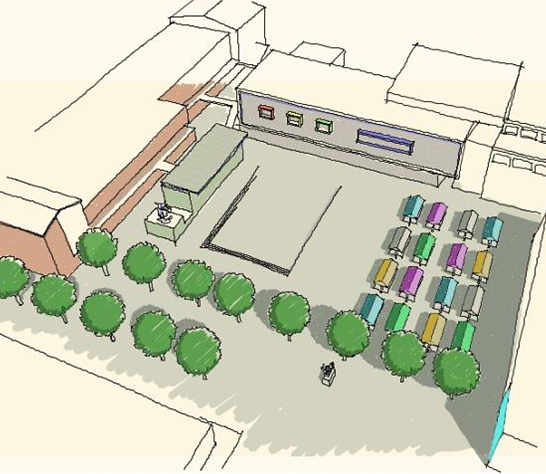
We propose that, further to the removal of the fixed stall canopies, the market be relocated so that it is visible, but does not dominate the whole aspect, from the main axis running up Broad Walk. This would reduce the area occupied by the market thus offering the possibility of an intensification of activity on this primary axis and would free up space for complementary activities within the square.


In relocating the market to the Eastern edge of the Square there exists an opportunity to reinvent and reinvigorate the market itself. One of the problems that the current arrangement creates is that the concept of a traditional general market has been lost. The current offering of stalls is somewhat varied and many traders have been allowed to sprawl across a number of pitches in an effort to make the market look larger than it is.

We would encourage the Council to explore the possibility of reducing the size of individual pitches to create a larger number of smaller pitches with a greater variety of goods. Whilst we recognise that the current economic circumstances and the rise of supermarkets have threatened the future of markets, we believe that a market that offers start up businesses and small traders an opportunity to display and sell their wares without the high overheads that a shop or similar premises would entail will generate visual variety and interest and, in turn, attract footfall.  


By providing other activities within the Market Square, casual shopping at stalls could begin to occur. It is also possible that specialist markets could occupy stalls from time to time to tie in with specific events that might take place in the newly created activity space.

Pitch sizes could be determined either by the use of markers within the paving of this area or, alternatively, by the design and construction of properly considered semi-permanent stalls.


Creating new visible activity:

Strengthening the visibility of existing activity within Market Square is a sensible and cost effect starting point, however the introduction of new activity is central to restoring a sense of destination and purpose for this key urban square. The relocation of the market will not only make it more visible from the main shopping area of Broad Walk but will also free up space for other activities. Whilst a vibrant market may well be sufficiently attractive to increase footfall during the day and could function, on occasion, into the evening, it is unlikely that it will be able to generate additional evening activity in Market Square all year round. The right additional evening activity in Market Square could, however, increase the market’s night-time viability.

We propose that the Council refurbish the existing two storey building to the western side of Market Square. This building could accommodate a gallery and perhaps an information centre dedicated to Harlow New Town, its architecture, planning, sculpture, biodiversity and all the other assets the town possesses. The gallery could support the Gatehouse Arts Project as well as existing, established local artists. It could also provide a “neutral” exhibition venue for future consultation on the regeneration of Harlow.


Coupled with the refurbishment of this unused building, and key to increasing the vitality of the square, we propose that an external video screen be erected on the side of the building, facing the square, and an associated programme of public realm works be undertaken to create an outdoor cinema which could be used to screen films. We propose that this space would also create a venue for performance art, school shows, concerts or other such seasonal activities. During the day the screen could be used to raise revenue by screening adverts or perhaps screen channels such as BBC News 24, providing animation. It could display video art related to the gallery use.

By adjusting levels in front of the proposed screen, a stage area can be formed with a lower level area for seating. This area could feasibly be transformed into a skating rink in the winter months. We propose that the single storey Market Office be retained to form a plinth for a major piece of sculpture.

To support the newly created open air cinema and performance venue, we would suggest that one of the adjacent vacant retail outlets to hire out deck chairs, which would also potentially generate revenue. We would also encourage the Council to establish a programme of events and entertainment for this outdoor facility that coincides with the programme of exhibitions etc in the newly created internal gallery spaces. If properly considered, a programme of night markets timed to coincide with events could prove to be very successful.


The introduction of a facility such as proposed here will provide a much needed focal point for the square, during the day this new public space would provide a quality environment for those who work in the surrounding offices or who are shopping in the Town Centre and, at night, could provide an incentive for people to use Market Square as a social gathering spot. When coupled with a vibrant night market, the square can become, once again, the location for communal gatherings and celebrations in Harlow, with the jostling crowds, strident colours and sounds envisaged at the inception of the square.


Creating a sense of place and destination:

The reorganisation and reinvigoration of the market, coupled with the introduction of a viable use for the vacant building in Market Square will go a long way towards creating a sense of activity and “destination” but the square itself needs to be redefined physically to make it a more intimate urban space.

We propose introducing trees (see above) to define areas of the greater square as more intimate spaces to meet friends, rest and play. The trees will also provide a heightened sense of enclosure to the square as a whole whilst still allowing the capacity for larger gatherings. The proposed line of planting frames a view of the Adams House Clock and would establish a strong, natural, backdrop for the listed sculpture on the axis of Broad Walk. Introducing mature trees would provide a natural softening to complement the hard surfacing of the square and surrounding areas.


We also suggest that a high impact lighting scheme is designed and implemented for Market Square. The scheme should not only improve the levels of general lighting in the square at night, which will encourage people to gather in this important urban space, but should also highlight the physical attributes and features of the surrounding buildings, for example the clock and the concrete perimeter of the glazing to the building on the northern boundary of the square, helping to reinforce the sense of place and identity of Market Square.


Creating a quality public realm:

It is not sufficient to simply create and enhance activity in Market Square if the intention is to reinvigorate this end of the Town Centre and thus attract a higher quality of retailer to Market Square. For Landlords and Retailers to have confidence in the area, the interventions that are made must be seen to be made in a meaningful and committed manner. Key to achieving this is investment in the Public Realm: This should be a mixture of short, medium and longer term strategies to further enhance the urban space over and above the improvements outlined in this document.

In the short term, the strategy should focus on short term gains that can be made without great financial expenditure. For example painting the hand railings around the raised walkways and staircases of The Rows would indicate a level of commitment to the area immediately.

In the medium term, a full programme of refurbishment and replacement of pavings and signage should be developed as this will have a significant impact upon the visual quality of the square. The programme could be implemented over time, for example the removal of the permanent canopies could include the repaving and formation of the sunken area proposed elsewhere in this document however, an overarching design should be agreed as soon as possible to avoid abortive or repetitive works.


In the long term, we would encourage working with surrounding land owners to address the issues of poor maintenance of the facades overlooking Market Square. These works could be as simple as instigating a proper redecoration and maintenance programme. An example of a more ambitious approach would be to see Market House reglazed with a contemporary curtain walling system and have the projecting elements expressed, using coloured renders, as architectural elements. This building has the potential to become a striking, iconic, architectural feature helping to establish a strong identity for the whole of Market Square.